
.
Sunday, October 12, 2014


Saturday, October 11, 2014
Sunday, September 28, 2014
The Douglaston Salmon Run: An Unsolicited Review - Redux
As steelhead season creeps ever closer, I cannot help but think about the Salmon River and the water I hope soon to fish. Some of that water runs through the Douglaston Salmon Run, and in the coming weeks I'll likely end up fishing there once or twice. What follows is a review I wrote of the DSR some two years ago. I find my position hasn't changed so I thought I'd republish it for the sake of anyone who might be interested.
Until recently, I found distasteful the notion of paying a fee to fish. I'm not entirely sure why, but I did.
Perhaps it's my blue collar roots. I grew up in a household where my parents worked alternating shifts - often double shifts - and only rarely had more than a few dollars to show for their efforts. Paying to fish seems a waste when so much water - excellent water in fact - may be accessed for free.
Perhaps it's that uniquely American ideal that juxtaposes our love of free and open spaces with the honored tradition of the ownership and cultivation of private property. Certainly, these concepts are sometimes at odds.
Perhaps it is because this is the United States and not the United Kingdom. Our European bug-chucking brothers and sisters have for centuries been paying tuition and fees to fish. We yanks have never been comfortable with the idea.

Perhaps there is some small part of me that resents the opportunities of folks who have the financial means to enjoy the kind of fishing about which I'll only ever dream. I'll likely never climb the hills and mountains of New Zealand, or wade the flats off the coast of Belize. I'll never watch golden dorado herd bait through currents of a Bolivian river, and Costa Rican roosterfish will never chase my poorly tied flies. My jealousy is ugly and baseless, but I'd be something less-than-honest if I didn't admit to it just the same.
All this brings us to the Douglaston Salmon Run. For two reasons - at least to my way of thinking - the DSR has been a source of some controversy here in New York. Foremost, the resort limits access to its nearly two river miles of river frontage on what is arguably one of the best salmon and steelhead fisheries in the entire Great Lakes region, the Salmon River. The resort was also at the heart of a landmark legal case here in New York that - for all practical purposes - grants land owners rights of ownership (and therefore the ability to post and limit access) to the river that flows through their property. In other states, one can access rivers from any public access point (i.e. a bridge) and walk the bank along private land up to the river's normal high-water mark.
The Douglaston decision made possible the posting of land through which my home rivers flow, and as a consequence of my anger at having been refused access to water at home, I refused to pay to fish the DSR's private water when I visited the Salmon River. For all the aforementioned reasons, I was bitter about the DSR's posting of a piece of water that benefits from the public's tax dollars - in the form of a very successful hatchery program that stocks the river with both salmon and trout. For years, I abstained from some of the best and most interesting fishing on the river because I didn't want to pay for something that I thought should be free, and I was vocal in my opposition.

I don't know if I was necessarily right or wrong in any of my attitudes, but I can tell you that some of my preconceptions about the Douglaston were fundamentally flawed. Having spent the past three seasons wading with some frequency the DSR's water, I've come to realize a few things about the resort, its staff, clients, and its fishing.
First, the fishing on the DSR's property is arguably some of the best on the Salmon River. There are excellent angling opportunities throughout the fishery (my favorite runs are all on public water), but the DSR does have something that much of the rest of the river lacks.
Fresh fish.
Situated at the head of the Salmon River's estuary, the DSR's property is the first bit of river that many of Lake Ontario's salmon and trout will run as they make their way upstream to spawn. As a result, the fish in the low end of the watershed are often bright silver and energized to the point of being electrified. This is true for the river's king salmon as much as it is its steelhead. I find that fresh, silver fish simply fight harder than their river-darkened brothers and sisters, and bringing a bright fish to hand is just a little bit more gratifying than catching a fish that has seen the fishery's entire length.

For the past several seasons, the Douglaston Salmon Run has maintained a policy of no-kill on trout throughout the property's length. Much of the rest of the river has liberal daily limits on trout and salmon. As a consequence, fish are often killed well before they've a chance to spawn. My secret hope is that the DEC will institute no-kill regulations on wild fish that haven't a clipped adipose fin, but until legistlators and regulators demonstrate the courage to enact such a rule, the Douglaston's policy is a step in the right direction for the fishery and its anglers.
We should note that the DSR is in many ways a microcosm of the larger river system. The Douglaston's property contains any type of water one might hope to fish: classic runs and glides, green-black pools, heavy riffles and pocket water. Whether one nymphs or swings, there is a place on the DSR to do whatever it is one likes to do, and the quality of the fishing hints at what could be possible throughout the entire system if similar, enlightened regulations were adopted river wide.

The Douglaston Salmon Run: An Unsolicited Review
Until recently, I found distasteful the notion of paying a fee to fish. I'm not entirely sure why, but I did.
Perhaps it's my blue collar roots. I grew up in a household where my parents worked alternating shifts - often double shifts - and only rarely had more than a few dollars to show for their efforts. Paying to fish seems a waste when so much water - excellent water in fact - may be accessed for free.
Perhaps it's that uniquely American ideal that juxtaposes our love of free and open spaces with the honored tradition of the ownership and cultivation of private property. Certainly, these concepts are sometimes at odds.
Perhaps it is because this is the United States and not the United Kingdom. Our European bug-chucking brothers and sisters have for centuries been paying tuition and fees to fish. We yanks have never been comfortable with the idea.
Perhaps there is some small part of me that resents the opportunities of folks who have the financial means to enjoy the kind of fishing about which I'll only ever dream. I'll likely never climb the hills and mountains of New Zealand, or wade the flats off the coast of Belize. I'll never watch golden dorado herd bait through currents of a Bolivian river, and Costa Rican roosterfish will never chase my poorly tied flies. My jealousy is ugly and baseless, but I'd be something less-than-honest if I didn't admit to it just the same.
All this brings us to the Douglaston Salmon Run. For two reasons - at least to my way of thinking - the DSR has been a source of some controversy here in New York. Foremost, the resort limits access to its nearly two river miles of river frontage on what is arguably one of the best salmon and steelhead fisheries in the entire Great Lakes region, the Salmon River. The resort was also at the heart of a landmark legal case here in New York that - for all practical purposes - grants land owners rights of ownership (and therefore the ability to post and limit access) to the river that flows through their property. In other states, one can access rivers from any public access point (i.e. a bridge) and walk the bank along private land up to the river's normal high-water mark.
The Douglaston decision made possible the posting of land through which my home rivers flow, and as a consequence of my anger at having been refused access to water at home, I refused to pay to fish the DSR's private water when I visited the Salmon River. For all the aforementioned reasons, I was bitter about the DSR's posting of a piece of water that benefits from the public's tax dollars - in the form of a very successful hatchery program that stocks the river with both salmon and trout. For years, I abstained from some of the best and most interesting fishing on the river because I didn't want to pay for something that I thought should be free, and I was vocal in my opposition.

I don't know if I was necessarily right or wrong in any of my attitudes, but I can tell you that some of my preconceptions about the Douglaston were fundamentally flawed. Having spent the past three seasons wading with some frequency the DSR's water, I've come to realize a few things about the resort, its staff, clients, and its fishing.
First, the fishing on the DSR's property is arguably some of the best on the Salmon River. There are excellent angling opportunities throughout the fishery (my favorite runs are all on public water), but the DSR does have something that much of the rest of the river lacks.
Fresh fish.
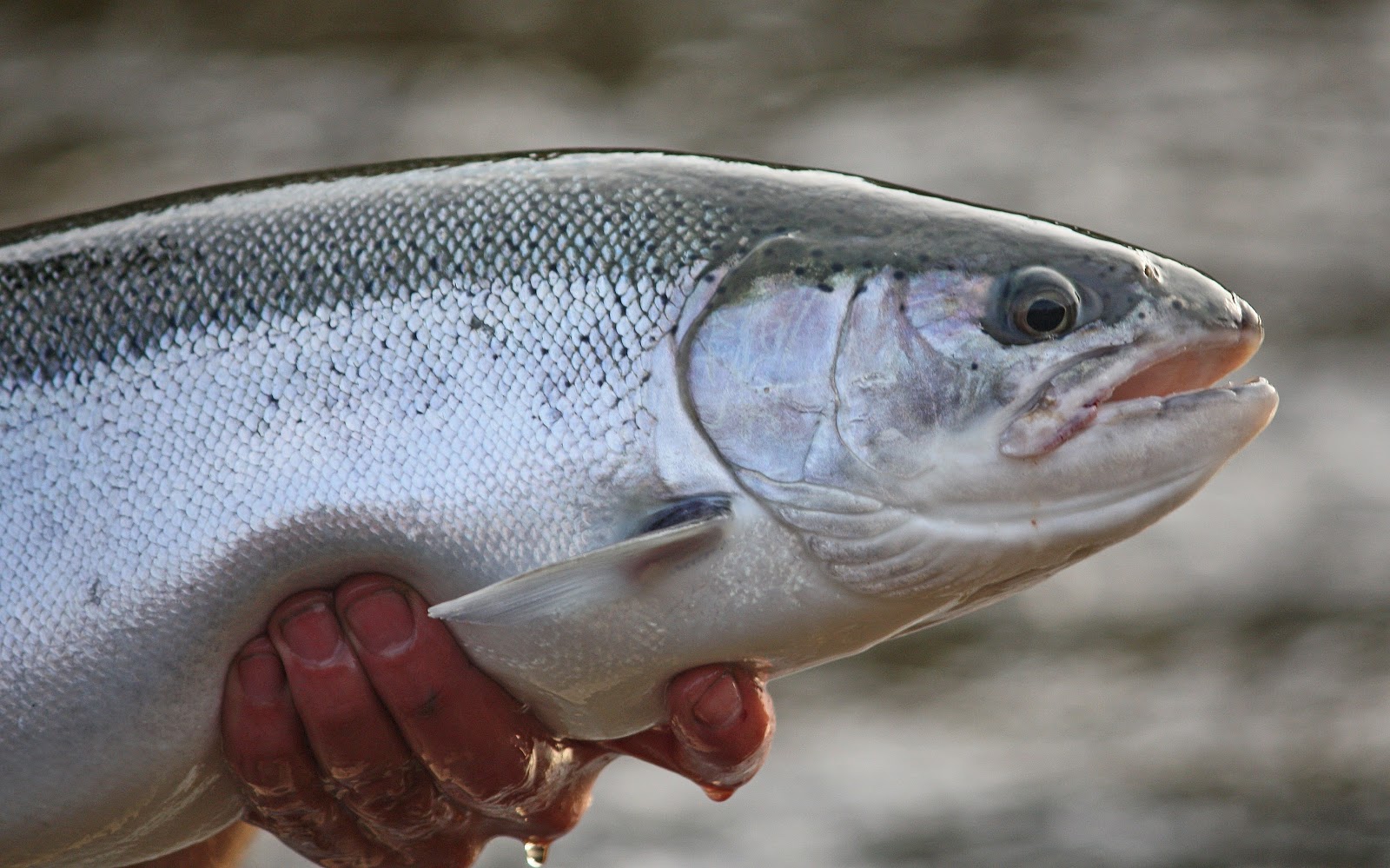
Situated at the head of the Salmon River's estuary, the DSR's property is the first bit of river that many of Lake Ontario's salmon and trout will run as they make their way upstream to spawn. As a result, the fish in the low end of the watershed are often bright silver and energized to the point of being electrified. This is true for the river's king salmon as much as it is its steelhead. I find that fresh, silver fish simply fight harder than their river-darkened brothers and sisters, and bringing a bright fish to hand is just a little bit more gratifying than catching a fish that has seen the fishery's entire length.
We should note that the DSR is in many ways a microcosm of the larger river system. The Douglaston's property contains any type of water one might hope to fish: classic runs and glides, green-black pools, heavy riffles and pocket water. Whether one nymphs or swings, there is a place on the DSR to do whatever it is one likes to do, and the quality of the fishing hints at what could be possible throughout the entire system if similar, enlightened regulations were adopted river wide.

Fishing aside, the DSR's staff does a fine job of maintaining its facilities and trails, which provide for easy access to any of the resort's 12 or 15 distinctly named runs and holes. While there is something to be said for having to bushwhack one's way to a stream, there is likewise something to be said for being able to take a leisurely stroll along the bank, and the older I get the more appreciate the stairway that leads from the Douglaston's main parking lot, down to the water.
And what of the 800 pound gorilla in the room? What about the cost? Season passes (unlimited access to DSR property from opening in mid August to closing in mid May) run $450.00, and Steelhead Season passes (unlimited access to DSR property from mid November to closing in mid May) cost $300.00. Both season pass holders also receive free daily passes to be used by the pass holders' guests whenever they together visit the property (limited guests per pass).
Upwards of $300.00 too steep a price to pay? I have to say that with three kids at home and all that entails, the price of a season pass - even the less costly steelhead season pass - is a little too much for me. My wife would argue that I don't need to pay for fishing when there is so much public water - and good public water at that - to fish free of charge. She would be right to make that argument.
But to access the DSR's property, we need not pay hundreds of dollars for a season pass. Instead, we may opt to purchase a daily pass for which the Douglaston charges $45.00. Forty-five dollars? I know. I do. I found it as hard to swallow as you do, but then a friend who frequents the DSR - and has for several years - explained to me his way of thinking.

As hard as it may be to believe, the gentlemen in this video recorded themselves fishing the DSR's water, and then posted their antics to YouTube. If you can bear to watch long enough, you'll eventually see that one of the Douglaston's river walkers approaches the group.
We can't be sure how much the DSR's employee saw that day. We can't be sure that he was ever in a position to curtail these men snagging fish. What we can be sure of is that the snagging continued after he walked on. This is unacceptable, and against both New York State law and the DSR's stated policy of enforcing that law.
I think I'll finish simply by saying that I've always enjoyed my time on the Douglaston's water. Some days have been better than others, but such is the nature of fishing. Critics might say that I'm a hypocrite, that I subsidize the people who would seek to make inaccessible the water I would fish. I don't know. Perhaps I am a hypocrite, but it seems to me that the DSR does not make inaccessible the water passing through through its property. Rather, the DSR simply limits access to that land. The fee to use this land is not extravagent, and the value of the experience is well worth the price. Would I prefer that the law reads as it does in so many other states, allowing anglers to access the water from any public site? Of course I would, but in the interim the DSR seems to have found a reasonable compromise, and I am grateful for that compromise.
Upwards of $300.00 too steep a price to pay? I have to say that with three kids at home and all that entails, the price of a season pass - even the less costly steelhead season pass - is a little too much for me. My wife would argue that I don't need to pay for fishing when there is so much public water - and good public water at that - to fish free of charge. She would be right to make that argument.
But to access the DSR's property, we need not pay hundreds of dollars for a season pass. Instead, we may opt to purchase a daily pass for which the Douglaston charges $45.00. Forty-five dollars? I know. I do. I found it as hard to swallow as you do, but then a friend who frequents the DSR - and has for several years - explained to me his way of thinking.

How much do we pay to go to a concert or to see a film? How much do we pay for a tank of gas or a meal at our favorite restaurant? What's a round of golf cost these days? How about a gallon of milk, a bottle of water, or a six pack of a small batch IPA? The point is that we spend our money in myriad ways, and never think twice about the real cost of things. When observed through the prism of value, I think the price of a daily pass on the DSR is more than reasonable.


Before you begin to wonder whether the DSR has put me on the payroll, please know that there are some ways in which I think the Douglaston Salmon Run could be improved. The first of these is the angler education and the enforcement of the legal and ethical rules of angling. As is the case throughout the river system, far too many anglers that frequent the DSR simply do not understand the difference between catching a salmon or trout fairly, and landing that fish after illegally snagging the animal in its body.
Make no mistake, snagging is every bit as prevalent on the DSR as it is on the upstream sections of the river. This is especially true during the height of salmon season. Consider the following video ...
Make no mistake, snagging is every bit as prevalent on the DSR as it is on the upstream sections of the river. This is especially true during the height of salmon season. Consider the following video ...
As hard as it may be to believe, the gentlemen in this video recorded themselves fishing the DSR's water, and then posted their antics to YouTube. If you can bear to watch long enough, you'll eventually see that one of the Douglaston's river walkers approaches the group.
We can't be sure how much the DSR's employee saw that day. We can't be sure that he was ever in a position to curtail these men snagging fish. What we can be sure of is that the snagging continued after he walked on. This is unacceptable, and against both New York State law and the DSR's stated policy of enforcing that law.
I think I'll finish simply by saying that I've always enjoyed my time on the Douglaston's water. Some days have been better than others, but such is the nature of fishing. Critics might say that I'm a hypocrite, that I subsidize the people who would seek to make inaccessible the water I would fish. I don't know. Perhaps I am a hypocrite, but it seems to me that the DSR does not make inaccessible the water passing through through its property. Rather, the DSR simply limits access to that land. The fee to use this land is not extravagent, and the value of the experience is well worth the price. Would I prefer that the law reads as it does in so many other states, allowing anglers to access the water from any public site? Of course I would, but in the interim the DSR seems to have found a reasonable compromise, and I am grateful for that compromise.
Thursday, September 11, 2014
Hard to Concentrate
Today, I find it hard to concentrate.
Thirteen years ago (good God, has it been that long?) I was in my classroom when the first plane hit the World Trade Center. My students and I watched - dumbstruck and horrified - as the second plane hit its target. I can't remember ever having been so angry.
Thirteen years, but it seems like only yesterday. The memory is fresh, and so too is that anger.


God bless the souls of those poor unfortunates who - thirteen years ago today - lost their lives to a hateful ideology. God bless their families. God bless our soldiers, sailors, airmen, and marines who fight to right a wrong and to keep the rest of us safe, and God bless the United States of America.
A genuinely riveting account of 9/11 from the perspective of a former Special Forces (Green Beret) medic who was in the WTC when the first plane hit ... Click HERE.
Thirteen years ago (good God, has it been that long?) I was in my classroom when the first plane hit the World Trade Center. My students and I watched - dumbstruck and horrified - as the second plane hit its target. I can't remember ever having been so angry.
Thirteen years, but it seems like only yesterday. The memory is fresh, and so too is that anger.
Today, The Rusty Spinner isn't thinking much about fishing.


God bless the souls of those poor unfortunates who - thirteen years ago today - lost their lives to a hateful ideology. God bless their families. God bless our soldiers, sailors, airmen, and marines who fight to right a wrong and to keep the rest of us safe, and God bless the United States of America.
A genuinely riveting account of 9/11 from the perspective of a former Special Forces (Green Beret) medic who was in the WTC when the first plane hit ... Click HERE.
Friday, September 5, 2014
Bests
Oftentimes, we bug chuckers measure our success as piscatorial masters of the universe in terms of personal bests: our best trout, our best cast, our best fly, even our best knot. Our continued ability to match or eclipse a previous record is how we convince ourselves that we're fine - fine fishermen. We say in our minds that if the apocalypse was to come tomorrow then we could provide needed sustenance for our loved ones, and our families would finally be forced to acknowledge and value our prowess with the long rod.

Consider the fella' in the above photograph. Tim Blair (you may recognize him from S.S. Flies and Tim's Warm Water Flies) has been fishing the Lake Ontario watershed since he was a boy. In the 20-odd years that he's chased steelhead on the Salmon River, the specimen pictured above is his best. This fish - caught on day one of a four day bender - made his trip. Tim was as happy as he was not because he bested a fish but because he bested himself (and inebriation), and demonstrated his skill at hooking and playing such a trophy before a very appreciative audience. I maintain that he's more lucky than good, given his lack of sobriety at the moment of the hook-up.

Typically, I do not catch very many big fish. My friends do, but either through a general lack of luck or skill, the river gods never seem to smile on me quite the way they do the people with whom I surround myself. And the truth is that I've come to terms with my turn of fate being what it is, because sometimes the biggest fish aren't what matters most. With all due respect to Shawn and Tim, sometimes catching just the right fish at just the right time is what most matters.

Consider another of my good friends, Ben Jose. Ben is one of the hardest working men I know. He runs his own business - Benjamin Bronze Studios - and he genuinely cherishes the little bit of time he gets on the water. Ben has caught any number of outsized fish in his day, but if you were to ask him he would almost certainly suggest that his best fish was a brown trout that came to hand at the end of his very first day on the Salmon River in New York. Ben was relatively new to fly fishing then, and the boys giving him a tour of the river did all they could to make sure he paid his dues: he was mercilessly ridiculed, made to fish the least productive parts of the run, and called on repeatedly to net fish for his "friends" as they hooked up many times throughout the day.
Through it all, Ben was resolute and never allowed his frustration to show. In the waning daylight - just minutes before regulations demanded anglers stop fishing for the day - he hooked and played to the net a genuinely magnificent fish. As impressive as it was, the brown trout wasn't Ben's best simply because of it's size. Rather, that trout remains a special fish because it was the proverbial pot of gold at the end of the rainbow. That trout signified Ben's resolve, his absolute refusal to have anything but a good time, and a willingness to learn lessons born of frustration and disappointment. Such lessons are difficult lessons to learn, but they are often the most useful.

As steelhead season creeps ever closer, I find myself looking forward to learning a few lessons of my own. I've no idea what they might be, but I know they're out there waiting for me, and that they'll be difficult lessons to learn. Steelhead lessons always are, but here's the thing: difficult lessons are often the best lessons, and the best lessons always help us to catch our best fish.
So as summer gives way to fall I find that I am hopeful; hopeful for my best steelhead, but more hopeful still, for my best day.


Consider the fella' in the above photograph. Tim Blair (you may recognize him from S.S. Flies and Tim's Warm Water Flies) has been fishing the Lake Ontario watershed since he was a boy. In the 20-odd years that he's chased steelhead on the Salmon River, the specimen pictured above is his best. This fish - caught on day one of a four day bender - made his trip. Tim was as happy as he was not because he bested a fish but because he bested himself (and inebriation), and demonstrated his skill at hooking and playing such a trophy before a very appreciative audience. I maintain that he's more lucky than good, given his lack of sobriety at the moment of the hook-up.
And then there's Shawn Brillon - one of the Orvis company's product developers. Shawn's best steelhead came on the same trip to the river. As you can see from the photo, the fish was a thick and powerful buck that weighed in at some 15 pounds (Boga-grip on the net ... not on the fish). That fish alone was reason enough to elicit a happy dance from the faithful employee of The Big O (he did dance ... I have it on video, and will happily sell to the highest bidder), but the quintessential icing on the cake was that the outsized buck took a traditional spey fly - an Orange Heron - on a long and slowly swinging line.

Typically, I do not catch very many big fish. My friends do, but either through a general lack of luck or skill, the river gods never seem to smile on me quite the way they do the people with whom I surround myself. And the truth is that I've come to terms with my turn of fate being what it is, because sometimes the biggest fish aren't what matters most. With all due respect to Shawn and Tim, sometimes catching just the right fish at just the right time is what most matters.
Through it all, Ben was resolute and never allowed his frustration to show. In the waning daylight - just minutes before regulations demanded anglers stop fishing for the day - he hooked and played to the net a genuinely magnificent fish. As impressive as it was, the brown trout wasn't Ben's best simply because of it's size. Rather, that trout remains a special fish because it was the proverbial pot of gold at the end of the rainbow. That trout signified Ben's resolve, his absolute refusal to have anything but a good time, and a willingness to learn lessons born of frustration and disappointment. Such lessons are difficult lessons to learn, but they are often the most useful.
As steelhead season creeps ever closer, I find myself looking forward to learning a few lessons of my own. I've no idea what they might be, but I know they're out there waiting for me, and that they'll be difficult lessons to learn. Steelhead lessons always are, but here's the thing: difficult lessons are often the best lessons, and the best lessons always help us to catch our best fish.
So as summer gives way to fall I find that I am hopeful; hopeful for my best steelhead, but more hopeful still, for my best day.
Sunday, August 31, 2014
Wednesday, August 20, 2014
A Boring Day
A great video, but I have to admit I'm only posting it here because it features the greatest animated character in all of television history.
Boring Day from JensenFlyFishing on Vimeo.
Boring Day from JensenFlyFishing on Vimeo.
Thursday, August 14, 2014
Don't Be This Guy
With salmon season just around the corner and steelhead season following close on its heels, you'll want to make sure you're not this guy ...
Of course, a fifteen minute walk in any direction from any of the Salmon River's public access areas will likely buy you all the solitude you'll need.
Of course, a fifteen minute walk in any direction from any of the Salmon River's public access areas will likely buy you all the solitude you'll need.
Tuesday, August 12, 2014
Losing Weight
When my wife was pregnant with our triplets she gained 100 pounds. One hundred pounds, and our children were six weeks premature. Of course, much of that 100 pounds was fluid; some of it - 15lbs 14oz to be exact - was baby. Most of Amy's weight gain, however, must have been love and hopeful anticipation because not once in seven and a half months of pregnancy did my wife complain. She was a trooper, and entirely dedicated to the well being of the lives growing inside her. All that having been said, she was more than happy to be rid of the weight once our children were born.

Now, to the point ...
Any of the three people who regularly read The Rusty Spinner are sure to know that this blog focuses much more on the why of fly fishing than it does the how of fly fishing. The how is done to death, and when it's done well, it is done much better than I am likely to do it. Over the past several years, however, I've had something of a revelation in my carp fishing that I think bears sharing: to follow the example of my wife and lose the weight.

I've been fly fishing for carp for over twenty years. When I began, I did what most bug chuckers do when they start chasing carp: I threw woolly buggers at them and hoped for the best. A typical outing had me fishing my home river for smallmouth bass, never targeting carp specifically, but always hoping I might find one willing to eat. Every so often I'd get lucky and cross paths with an enthusiastic fish rooting in the shallows, but these carp were always much more likely to spook than they were to take a #4 cone head woolly bugger.

As I matured as a carp angler - if such a thing as possible - and began to chase carp to the exclusion of other species, I tied flies that I thought would be more to their liking. These bugs were almost always constructed with tailing carp in mind. That is to say that they often mimicked crayfish and were heavily weighted - usually with beads or lead eyes - so that when cast to actively feeding fish they would drop straight to the bottom where tailing carp feed. If my casting was on point then chances were reasonably good that a fish would take. If my casting was off - even the least little bit - then the fish was likely to spook. Sometimes, the mere splash of my weighted fly entering the water was enough to send entire pods of fish scattering across the river.

And this is why I've decided to lose the weight. Small unweighted flies enter the water with much less commotion than do flies tied with bead chain, barbell eyes, beads, or even lead wire. As a consequence, I'm able to make multiple presentations to fish that would likely spook if presented with larger and heavier offerings. If made to guess, I would say that on average I am able to make five or ten times as many casts to fish when I am using unweighted flies than I might make with weighted offerings. I'm not a mathematician, but I'm fairly sure this makes me five or ten times more likely to hook a fish.

Of course, fishing with unweighted flies in the the rivers I frequent does present a particular challenge. If my target is rooting on the bottom or suspended mid column then I must cast far enough upstream to allow my fly time to sink into the fish's field of vision. More often than not, the carp I chase are unwilling to move very far in following a fly so my presentation must be in the fish's lane to be at all effective. This can prove difficult at first, but any bug chucker who has spent time fishing for stream trout has likely had thousands of opportunities to practice.

Now, to the point ...
Any of the three people who regularly read The Rusty Spinner are sure to know that this blog focuses much more on the why of fly fishing than it does the how of fly fishing. The how is done to death, and when it's done well, it is done much better than I am likely to do it. Over the past several years, however, I've had something of a revelation in my carp fishing that I think bears sharing: to follow the example of my wife and lose the weight.
I've been fly fishing for carp for over twenty years. When I began, I did what most bug chuckers do when they start chasing carp: I threw woolly buggers at them and hoped for the best. A typical outing had me fishing my home river for smallmouth bass, never targeting carp specifically, but always hoping I might find one willing to eat. Every so often I'd get lucky and cross paths with an enthusiastic fish rooting in the shallows, but these carp were always much more likely to spook than they were to take a #4 cone head woolly bugger.
As I matured as a carp angler - if such a thing as possible - and began to chase carp to the exclusion of other species, I tied flies that I thought would be more to their liking. These bugs were almost always constructed with tailing carp in mind. That is to say that they often mimicked crayfish and were heavily weighted - usually with beads or lead eyes - so that when cast to actively feeding fish they would drop straight to the bottom where tailing carp feed. If my casting was on point then chances were reasonably good that a fish would take. If my casting was off - even the least little bit - then the fish was likely to spook. Sometimes, the mere splash of my weighted fly entering the water was enough to send entire pods of fish scattering across the river.
And this is why I've decided to lose the weight. Small unweighted flies enter the water with much less commotion than do flies tied with bead chain, barbell eyes, beads, or even lead wire. As a consequence, I'm able to make multiple presentations to fish that would likely spook if presented with larger and heavier offerings. If made to guess, I would say that on average I am able to make five or ten times as many casts to fish when I am using unweighted flies than I might make with weighted offerings. I'm not a mathematician, but I'm fairly sure this makes me five or ten times more likely to hook a fish.
Of course, fishing with unweighted flies in the the rivers I frequent does present a particular challenge. If my target is rooting on the bottom or suspended mid column then I must cast far enough upstream to allow my fly time to sink into the fish's field of vision. More often than not, the carp I chase are unwilling to move very far in following a fly so my presentation must be in the fish's lane to be at all effective. This can prove difficult at first, but any bug chucker who has spent time fishing for stream trout has likely had thousands of opportunities to practice.
Friday, August 8, 2014
Tis the Season
It's that time of year when I start to daydream of steelhead. Of course, we have to make it through the summer and then salmon season, which brings us to this video ...
It's a little dated, but worth watching nonetheless. Forward to 3:00 or so to see the most interesting part.
It's a little dated, but worth watching nonetheless. Forward to 3:00 or so to see the most interesting part.
Subscribe to:
Posts (Atom)